

OSU undergraduate student discusses research and how it has helped shape her career
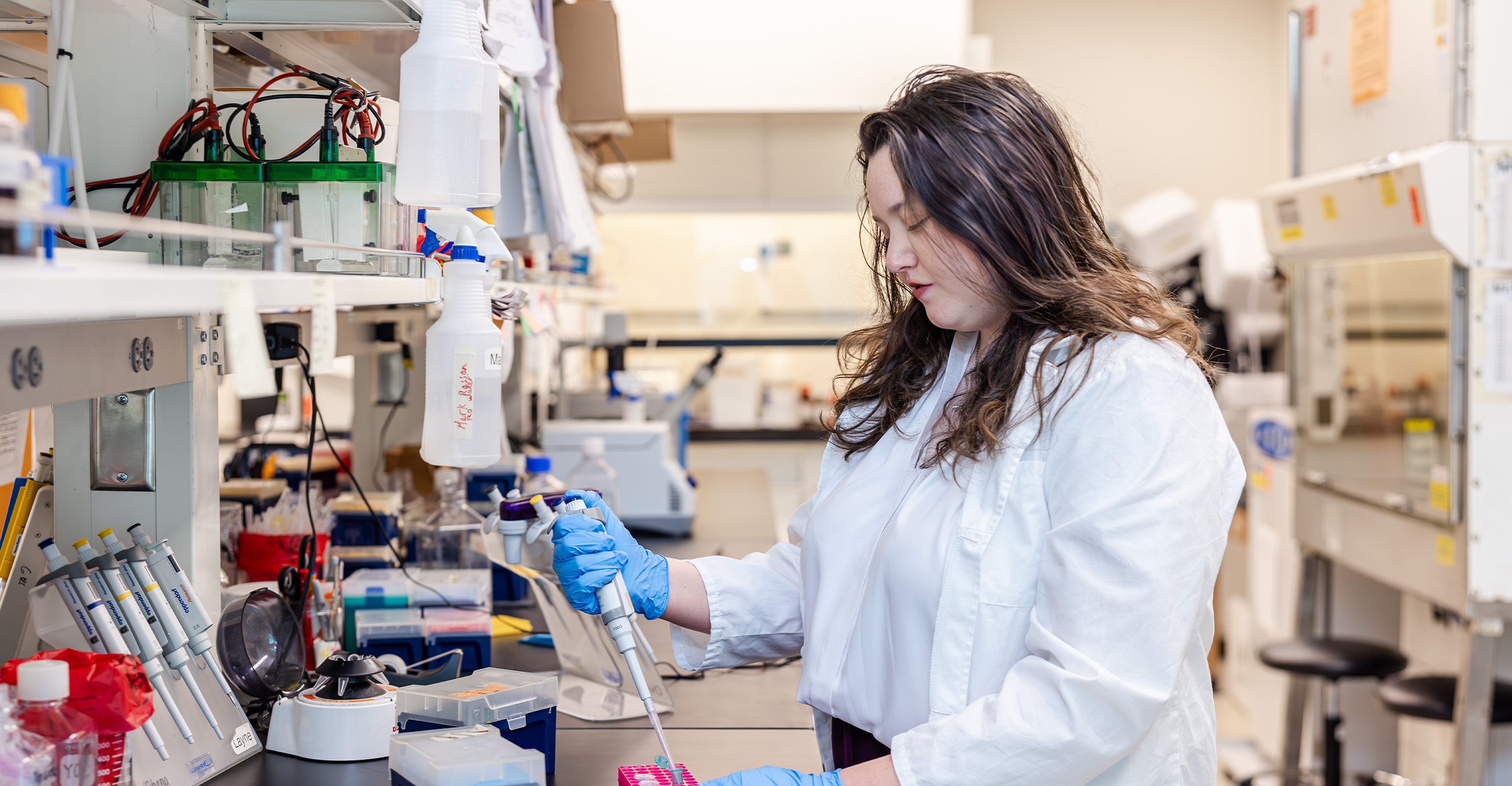
Amber Meeker is a senior zoology student at Oklahoma State University from South Carolina.
OSU sat down with Meeker to discuss the research she has helped conduct while earning her undergraduate degree and how it is shaping her career after her time in Stillwater.
Question: What first sparked your interest in undergraduate research at OSU, and how did you become involved with the Niblack Research Program?
Amber Meeker: I was interested in research in high school because I attended a college prep school that introduced us to research-oriented experiences. When I saw the opportunity to apply for OSU’s Freshman Research Program, I applied right away. Research is especially valuable for someone pursuing veterinary school because it sets you apart and builds critical skills.
I joined Dr. Cheng’s lab through the Freshman Research Program. Although I’m a zoology major in the integrated biology department, my research is in the biochemistry and molecular biology department, so it was a different academic environment. Dr. Cheng has been an incredible mentor who encourages all of us to pursue big opportunities.
My first year, I was a Freshman Research Scholar. My second year, I didn’t receive scholarships, but I continued researching over the summer and earned a publication. In my third year, I received the Niblack Scholarship. In my fourth year, I applied again and was awarded the Purdie Scholarship, which was a surprise since only four students receive it. Much of my journey is thanks to Dr. Cheng’s mentorship and encouragement, not just for me, but for all the undergraduates in his lab.
Q: How has working across zoology, natural resource ecology and management, and biochemistry shaped your research approach?
AM: Working across departments gives you insight into the different resources and strengths each one offers. It also highlights the importance of interdisciplinary collaboration. For example, Dr. Cheng’s lab collaborates with Dr. Lin Liu’s lab in the veterinary school, and both focus on respiratory illnesses. Through events like the Oklahoma Center for Respiratory and Infectious Diseases symposium, I’ve seen how researchers across OSU approach related questions from different angles.
Being in a highly technical, cell-based lab, rather than observation-based zoology labs, has strengthened my academic foundation. I often learn concepts in research before I encounter them in class. It has taught me how to read research papers independently, identify key findings and contribute meaningfully to discussions.
I added natural resource ecology and management in my final year because I wanted to take specialized courses like biology of fish and ornithology. Since it required only a few additional classes, it made sense to formally add the major.
Q: Can you explain your research in simple terms, and why it matters?
AM: My research focuses on microvesicles, tiny particles released by cells to communicate with other cells. These microvesicles carry signals and proteins that can influence how other cells respond to infection.
We’re studying how these microvesicles affect cells during infection, particularly whether they speed up or slow down the infection process and what proteins are involved. In one word, the project is about communication, how cells communicate with one another and how we can better understand that process.
This is especially important in the context of cystic fibrosis infections, where little is known about how these microvesicles function.
Q: What has been the most challenging part of your research?
AM: Working with cells requires a great deal of patience. They can become contaminated easily, and if something goes wrong, weeks of work can be lost.
I’m fortunate to be part of a strong team. For example, during one experiment involving a 96-well plate, we tested different cell lines and took more than 200 photos per day for five consecutive days. Having a team ensures that no one person carries the entire burden.
My graduate student mentor, Carlyn Guthrie, has taught me nearly everything I know in the lab. She creates a supportive environment where questions are encouraged. Even if I repeat a procedure after a long break, she’s always willing to walk through it again.
Q: How has undergraduate research shaped your confidence and identity?
AM: Research has been a significant confidence builder. When you specialize in a project, you develop deep expertise and present your work to professors and researchers. I’ve presented at more than 10 symposiums, including Oak Ridge (National Laboratory in Tennessee), which required a 10-minute presentation.
Through those experiences, I’ve learned that it’s okay not to have every answer. Sometimes the appropriate response is, “That’s outside the scope of this project, but it’s an interesting question.” That level of professional confidence is invaluable.
Research has also strengthened my teamwork and communication skills, both critical for veterinary medicine. As a veterinarian, you must communicate clearly, make informed decisions and work collaboratively. These research experiences have prepared me for that responsibility.