

A deep dive into OSU’s dolphin quest
The Oklahoma State University Aerospace Institute for Research and Education defies limitations in discovery. Recently, it has taken to the ocean for its ongoing work in marine mammalogy research.
Working with marine mammals is an exciting and rewarding field. However, several factors, including complicated technical skills, strict environmental regulations and strenuous field conditions, make collecting research data difficult.
Passive Health Assessment in Sea Mammals (PHASM) is a potential solution for many of these research hurdles. Created by OAIRE, PHASM is a non-invasive way of collecting important health data from marine mammals.
Daniel Gassen, a researcher and development engineer for OAIRE, began working on the project in 2022.
“Dolphins are often considered sentinel species. They can reflect changes in ocean and coastal ecosystems' health that may also affect other wildlife and even people,” Gassen said.
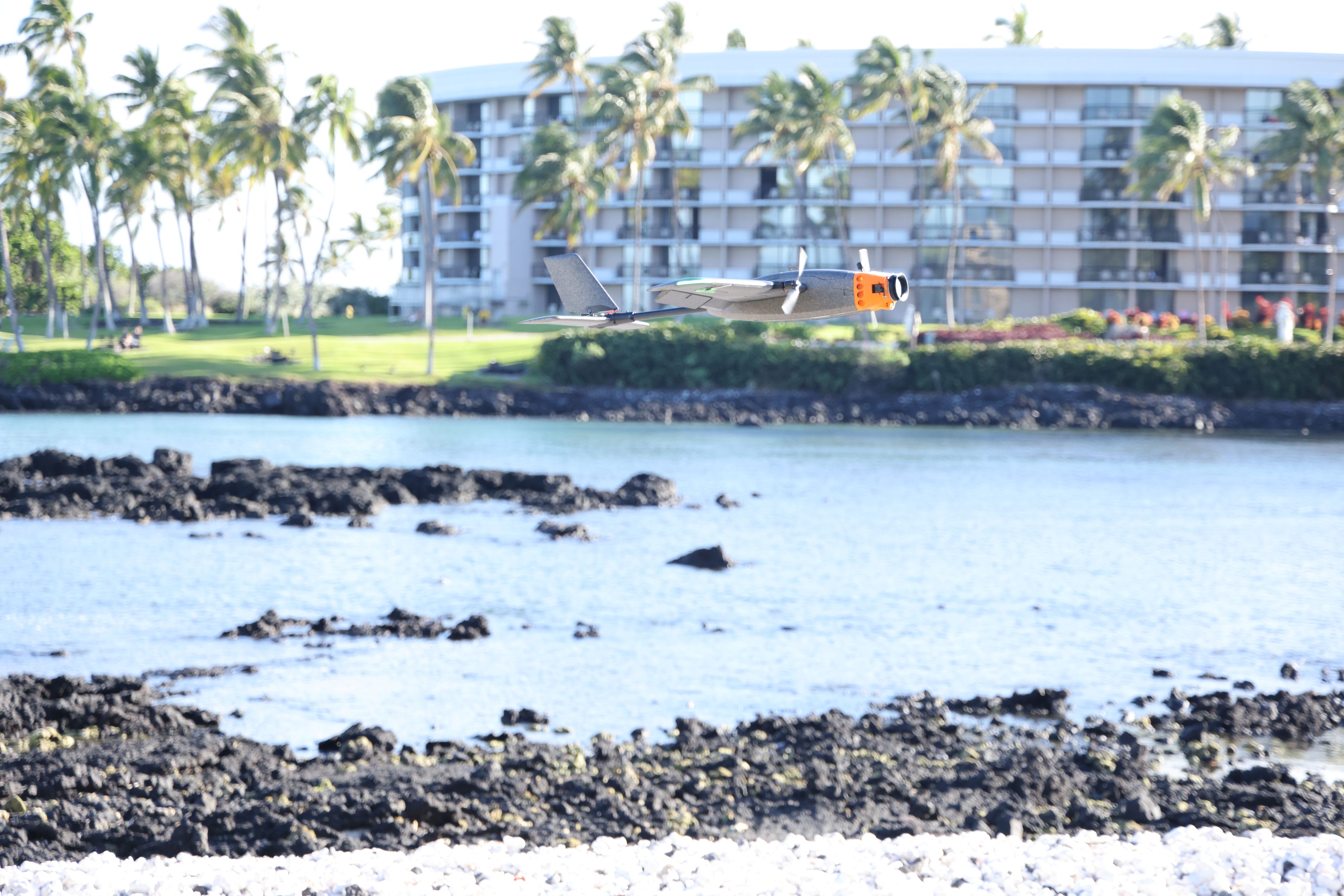
PHASM is a small fixed-wing drone that flies at low altitude over the water. When dolphins chuff — the exhalation of water and mucus when they come up for a breath — PHASM will vacuum it up and fly it back to the operator for testing.
Chuff can best be described as a dolphin sneeze that contains specific hormones, pathogens, DNA and other health indicators. The samples collected from dolphin chuff give humans important insights on the dolphin and its environment.
Unlike larger whales, dolphins produce a very small breath plume. Big drones with rotational blades will destroy these potential chuff samples, so the team developed PHASM to be the precise solution to this unique problem.
“By using fixed-wing aircraft, we’ve reduced both noise and disturbance to the animals while incorporating a specialized siphon collection system that helps capture more material each breath,” Gassen said. “The result is a non-invasive approach that allows us to gather valuable health information without having to handle the animal.”
The PHASM project requires one key element that it will never get in Oklahoma: the expansive ocean. So, Gassen and his team have traveled, and traveled some more, to research, fine-tune and showcase PHASM in action.
In February 2026, Gassen was honored with the Oklahoma Innovator Award for Outstanding Research & Development in Aerospace, an award which recognizes research work with real-world impact.
“These recognitions are a reminder that meaningful innovation can come from Oklahoma and be relevant well beyond our state. I hope it encourages more people to take on ambitious problems.”
Then in May 2026, the PHASM team traveled to Waikoloa, Hawaii, to demonstrate how their aerospace technology could be used under the sea.
The team presented this information at the Alliance of Marine Mammal Parks & Aquariums Annual Meeting at Dolphin Quest, which is a large conservation group. Dedicated to animal welfare, observation, scientific studies and education, Dolphin Quest has partnered with OAIRE to invest in this research.
This demonstration was a huge stepping stone toward future collaboration and expansion of PHASM to research institutions and conservationists around the world.
“These recognitions are a reminder that meaningful innovation can come from Oklahoma and be relevant well beyond our state,” Gassen said. “I hope it encourages more people to take on ambitious problems.”
Most recently, the team has worked consistently off the coast of Galveston, Texas, in partnership with Stephen F. Austin State University, Dolphin Quest and the Galveston Bay Dolphin Research Program to collect dolphin chuff samples from wild pods, not just dolphins under human care.
“Working with wild dolphins off the Texas coast was an important milestone,” Gassen said. "Demonstrating the system with wild animals is what PHASM was ultimately designed for.”
The future shines brightly for OAIRE and the PHASM team, as there is much to look forward to. Potential partnerships with the Georgia Aquarium will further expand PHASM’s breadth, and there's a rising excitement that after years of long preliminary research, PHASM is now being applied in the real world.
It is a big goal, but one day PHASM could be adapted to support research on a wide range of marine mammal species, rather than focusing solely on dolphins. The need for non-invasive processes for collecting scientific data on animals has steadily increased over time, as scientists understand that these procedures protect animal welfare, yield more natural behavior data and advance scientific accuracy.
Gassen said Dr. Jamey Jacob, executive director of OAIRE, offered him an opportunity to think differently about working and interacting with dolphins through PHASM.
“That experience gave me a new appreciation for these animals and a desire to protect them,” Gassen said. “Since then, I've seen PHASM as a way to make a meaningful impact by helping researchers monitor marine mammal health and make more informed conservation decisions.”
Such extreme dedication to a single project is admirable, with its narrow focus and no guaranteed results in any set time. For Gassen, that line of thinking is not the point.
“OAIRE has provided me with a really special opportunity to continue working on something I became passionate about during my master's research,” Gassen said. “That kind of long-term commitment is rare, and it's allowed PHASM to evolve from a research concept into a technology that's now being used in the field."