

Stabilizing Force
OSU researchers create ‘smoke alarm’ for earthquakes
An earthquake rumbles throughout your home’s interior, but the house stays intact.
Imagine not just your home staying safe but also bridges, skyscrapers and cultural landmarks. All thanks to a device an Oklahoma State University researcher is developing and testing at this very moment.
Dr. Priyank Jaiswal, a professor at the Boone Pickens School of Geology, conceived the idea in 2016 following a 5.8 magnitude earthquake in Pawnee, the strongest in Oklahoma’s history.
“I first thought about it as a smoke alarm. You just put it there, and if there is fire, it lets you know,” Jaiswal said. “How about we have a system that lets you know if your house isn’t doing so great?”
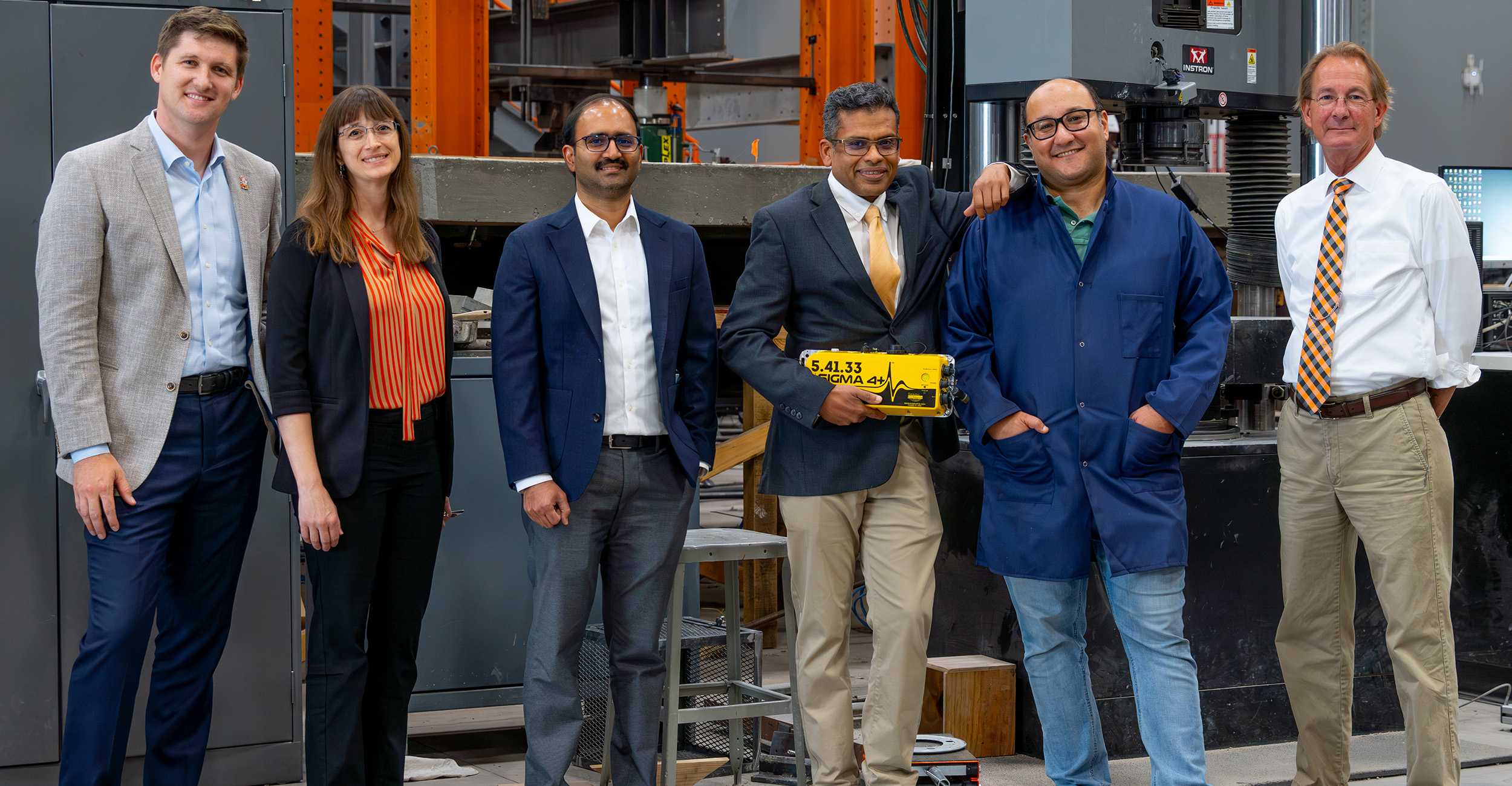
Jaiswal and Dr. Mohamed Soliman, an OSU civil engineering professor, were granted funding from the National Science Foundation to pursue the idea.
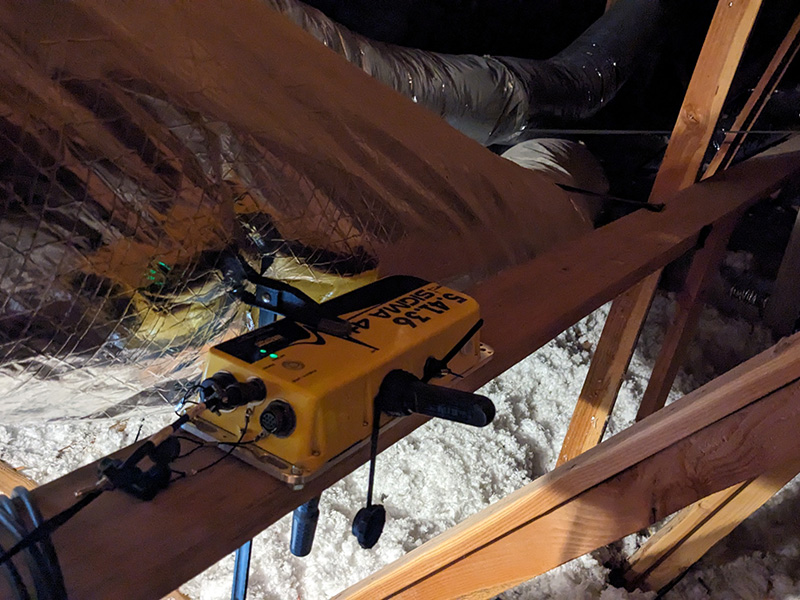
Their creation was Intact — a seismic device about the size of a shoebox. Jaiswal said it’s simple to use: Just clamp it to a structure’s foundation, and it connects to the WiFi, sending data to servers that can provide a digital footprint for the building. This allows people to see how often the structure is subliminally shaking and give them time to stabilize it in case of an earthquake.
“Our land-grant mission is to educate people and empower them,” Jaiswal said. “Having this technology installed, they can see and touch and collaboratively access this data.”
One example Jaiswal used for how beneficial Intact could be was the 2021 Surfside, Florida, condominium collapse that killed 98 people.
“Think about if such a sensor or such a system was in place and the owner of the building, or the management company, had an app on their cell phone or their computer that they would see any kind of alarm go off when the structure of the building seemed to be shifting,” Jaiswal said. “These things are slow. Actual fatigue starts from the inside, not the outside. By the time you see a crack in the wall, it’s already too late.
“So, what if management knew that something was coming six months before the actual incident? That’s a long enough time period for them to safely evacuate and rehabilitate.”
John Nickel, with OSU’s Innovation Corps, approached Jaiswal and Soliman about commercializing Intact for public use. With enthusiastic approval, the duo started looking for places to field test the device, settling on churches in Latin America.
Working with Association of Civil Engineers of the State of Puebla (CICEPAC) and the Nacional Institute of Anthropology and History (INAH) through Dr. Hugo Ferrer at the Civil & Environmental Engineering, Jaiswal visited the Cholula Pyramid site in Puebla, Mexico. The pyramid, which began construction in the 3rd century BC, is the largest in the world, though the Great Pyramid of Giza is taller.
In 1594, Spanish colonists built a church — Iglesia de Nuestra Señora de los Remedios — atop the pyramid. Over the centuries, the site has seen significant signs of fatigue because of natural aging and Mexico’s precarious position atop tectonic plates.
“Nobody going inside a church thinks about whether this church is going to be there tomorrow or not,” Jaiswal said. “It’s a pillar of the community. In many communities, it forms a part of their identity. So, having as much time in advance to have a plan in place as to what needs to be done if this church isn’t as safe as we thought it was is crucial.. Mexico has gone through two large earthquakes, and we can see clear signs of fatigue on the walls. Is it ready to take the third one? Maybe. If it took the third one, is it ready to take the fourth one? These are questions that you cannot easily answer without data.”
Although cultural heritage sites might be low on a nation’s priority list, the monuments are huge tourist attractions in Central American and Mediterranean countries where the risk of natural seismicity is high. Jaiswal sees a place for the device in almost every industry, from homeowners and civil engineers to even the energy field in areas like wind farms.
“My dream is to have it installed in every structure in the world,” Jaiswal said. “Every skyscraper, every drilling rig, anything where the structure is at risk from a natural element or from aging, should have this. It takes time. … But we’ll get there.”