

We Are Land-Grant
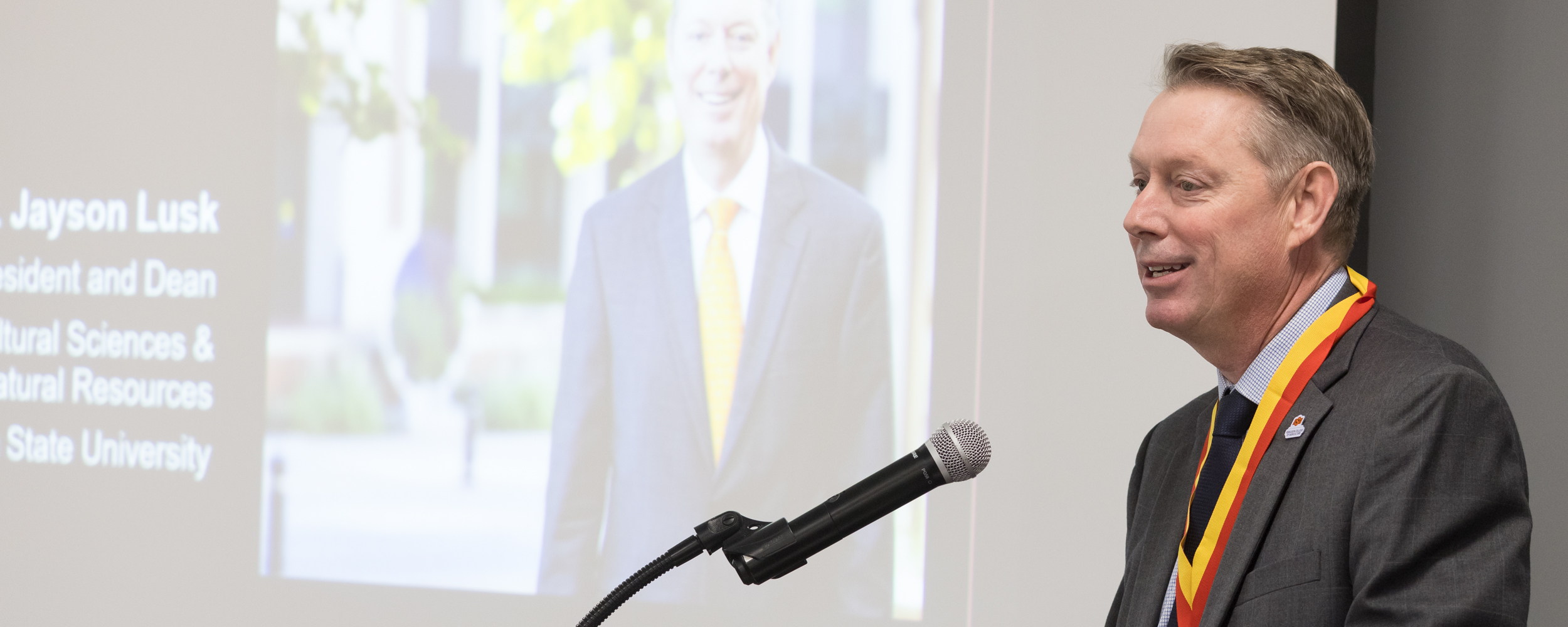
Dr. Jayson Lusk on supporting Oklahoma's food economy
Your browser does not support the
TRANSCRIPT:
Mack Burke: I'm Mack Burke, host of We Are Land Grant, and I'm joined today by Dr. Jayson Lusk, who has served as Vice President and Dean of OSU Agriculture since 2023. Dr. Lusk, welcome.
Jayson Lusk: Hi Mack. Thanks for having me on.
Mack Burke: What does the land-grant mission mean to you?
Jayson Lusk: A land grant university ideally should be a place that's accessible to everybody, that you could come get an affordable education.
We're here not to keep people out, but to let people in. The other adjectives that come to mind for me are service oriented. We wanna be a place where people can come and that they know that we can provide solutions to practical problems that impact people in their daily lives.
Mack Burke: How is ag research improving quality of life and economic opportunity here in Oklahoma?
Jayson Lusk: We try to have an impact in a variety of ways, but let's take about it on a really practical level. Say you're sitting down to eat a nice juicy burger. You got meat in the middle, and you got buns on the outside. Those buns come from flour that comes from wheat. Here at OSU, we produce varieties of wheat that are grown on over 70% of the acres in Oklahoma.
That means we produce the original seeds that, that get planted and, and, and flour into wheat. And, and what does that mean for a farmer? We're producing varieties of wheat that are more resistant to diseases, more resistant to certain pests. If we can do that, that means a farmer doesn't have to apply as much pesticide.
Increasingly, we're trying to produce varieties of wheat that have better baking properties so that all the bakers don't have to add a bunch of additives to it, or may even have better health properties, like more fiber or more antioxidants. And so, the inside of that burger has beef and we're working on breeding programs that produce cattle that are more productive and profitable for farmers but ultimately tastier for consumers.
Mack Burke: Can you tell me about OSU extension and how that helps you amplify the impact of OSU AG research
Jayson Lusk: Extension is the university's connection to local communities. We have extension educators throughout every county in the state of Oklahoma, and it's the way we make sure the knowledge that we create here in Stillwater get in the hands of the people that need it.
So that happens in a variety of ways. One is with youth. So the 4-H program is an extension program. We touch the lives of over a hundred thousand students every year through 4-H. And so, that's leadership education, but just teaching 'em practical information about food production, about dietary patterns.
But then we also go and work with farmers and rural communities to try to promote rural economic development and put the newest technologies in the hands of farmers and help them understand how to use it.
Mack Burke: How does your team stay responsive to emerging challenges like climate resilience, food insecurity, or evolving consumer expectations?
Jayson Lusk: One of the ways we try to stay responsive is by being involved. We do that through the extension service by being in connection and in community with the people around us. We try to stay involved in our agricultural farmer organizations, the Oklahoma Cattlemen's Association, the Wheat Commission, the peanut growers, these kinds of groups so that we hear the problems they're facing, and we can take those problems back to the lab or back to the field and work on them.
Mack Burke: And as someone who studies what we eat and why, what are some trends you're seeing and how can OSU help Oklahomans make informed decisions on these kinds of topics?
Jayson Lusk: One of the big trends we're seeing right now in the agricultural community is it's a tough time in the farm economy. Commodity prices are low, interest rates are high.
It's a tough time if you're a farmer, profitability is as low as it's been in several years, and so that's a trend we need to be in front of and help producers stay aware of the options available to them and help prepare them for the future. Another trend we're seeing is that people are just much more interested in where their food comes from, and I think it's one of our roles to help provide that education.
One of the things we have on campus here is a student farm. We've always had student farms on OSU campus where we train students, but this is our newest iteration where we have fresh vegetables that are getting grown here on campus. And we think that's a way to connect students who haven't had a traditional role in agriculture, but that have interest in where their food comes from to get engaged, get their hands a little bit dirty.
And learn whether this might be a career they want to be involved in all the while helping serve people in our community.
Mack Burke: Dr. Lusk, thanks so much for joining us.
Jayson Lusk: Happy to be here. Thanks for having me.