

We Are Land-Grant
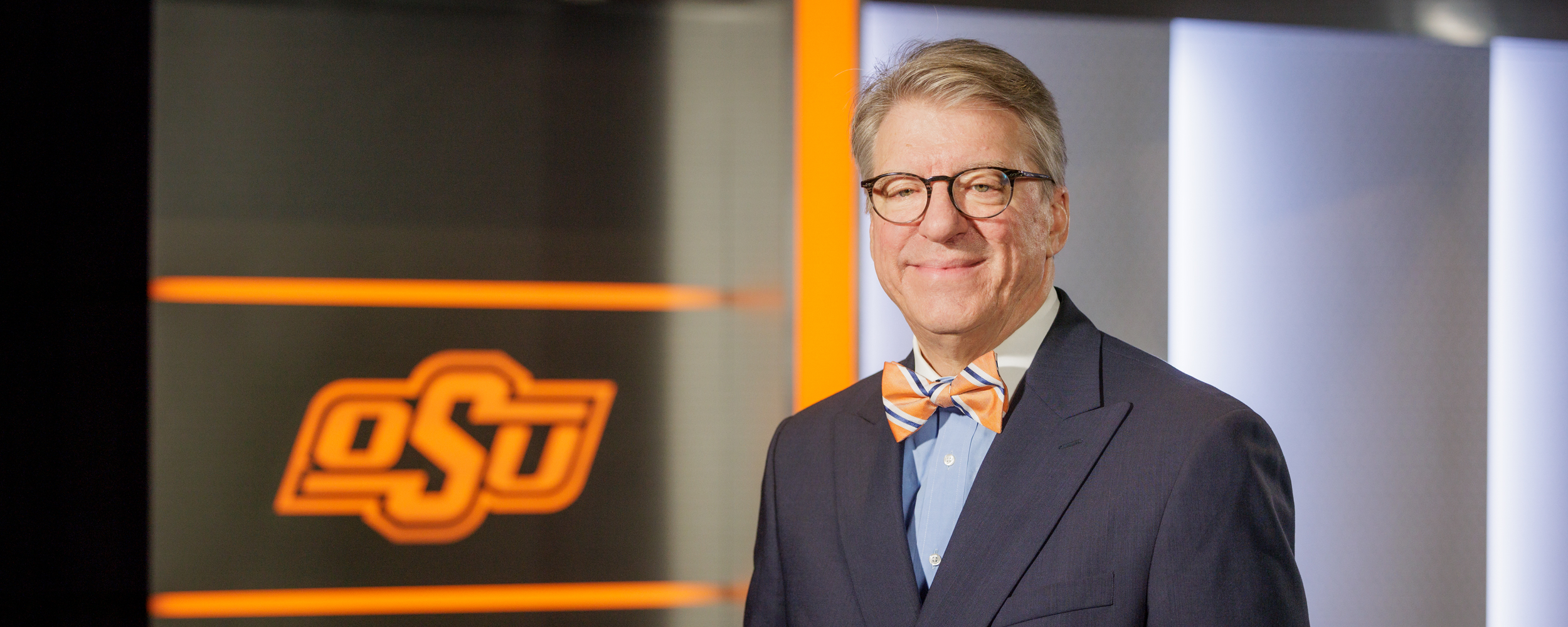
Jim Hess on his role as OSU's interim president
Your browser does not support the
TRANSCRIPT:
Mack Burke: I'm Mack Burke, host of We Are Land Grant, and I'm joined today by interim OSU President, Dr. Jim Hess. Jim, welcome.
Jim Hess: Thank you. I'm pleased to be with you.
Mack Burke: While you're new to your current role, you've spent over four decades advancing higher education in Oklahoma. Much of it right here at OSU. What key lessons have you learned during your career and how does that inform your leadership approach?
Jim Hess: Well, one of the first lessons I learned in higher ed was you have to do more with less. You have to figure out how to take the resources you have. Assume you're not gonna get any more and make the best use of those resources to accomplish the mission that you're required to accomplish.
Mack Burke: What legacy do you hope to leave as interim president?
Jim Hess: I have a very simple legacy that I'd like to be remembered for, that I left the place better than I found it. That simple.
Mack Burke: OSU has a proud history as a land-grant institution. How do you see that mission guiding the university's work today? And what does the Land-Grant mission mean to you?
Jim Hess: Well, the Land-Grant mission has a long history all the way back to the late 18 hundreds, and the primary land-grant mission for all land grant institutions, but specifically for OSU, is to train people to make practical solutions to problems that could be in agriculture, veterinary medicine, engineering. Those three, primarily providing solutions to practical, everyday problems to better people's lives.
Think of all of the development of this country in terms of industrial development. All of those things are a result of people being prepared at land-grant universities, engineering revolutions, manufacturing innovations.
All of those things are a direct result. Of people attending land-grant universities being trained, and then going out and doing innovative ideas, innovative solutions to everyday practical problems that better people's lives.
Mack Burke: A commitment to addressing societal challenges is a key part of the land-grant mission. How is OSU poised to make a positive impact in the near and long-term future?
Jim Hess: When you think about our state, most of our rural economy is based upon agriculture, food production. The pillars of that for us are veterinary medicine, agricultural education and agricultural development, scientific development for agricultural products, food production, science, all of those things that drive our rural economy.
There's a shortage of large and food animal veterinarians in every state that has an agricultural economy. So our job is to make sure that we are producing veterinarians who will serve in rural areas to support cattle production. Pork production, poultry production, all of those things that our food supply is based on.
So looking forward, in order to meet the shortages of rural veterinarians, you have to recruit people from rural environments, rural Oklahoma, train them and have 'em go back to rural Oklahoma to provide the services. They're so vitally needed.
Mack Burke: And what kind of investment does the CVM need right now?
Jim Hess: Right now, our number one priority for Oklahoma State University is to, along with our legislative partners, of course, is to build a state-of-the-art animal teaching hospital.
And so it's absolutely vital for our state and for Oklahoma State University to have a facility where we can attract the highest quality students and the highest quality faculty members to get the outcomes for rural Oklahoma.
Mack Burke: Jim, thanks again for joining us.
Jim Hess: My pleasure. Thank you for having me.