

Gates Cambridge finalist talks research, award and why he chose OSU
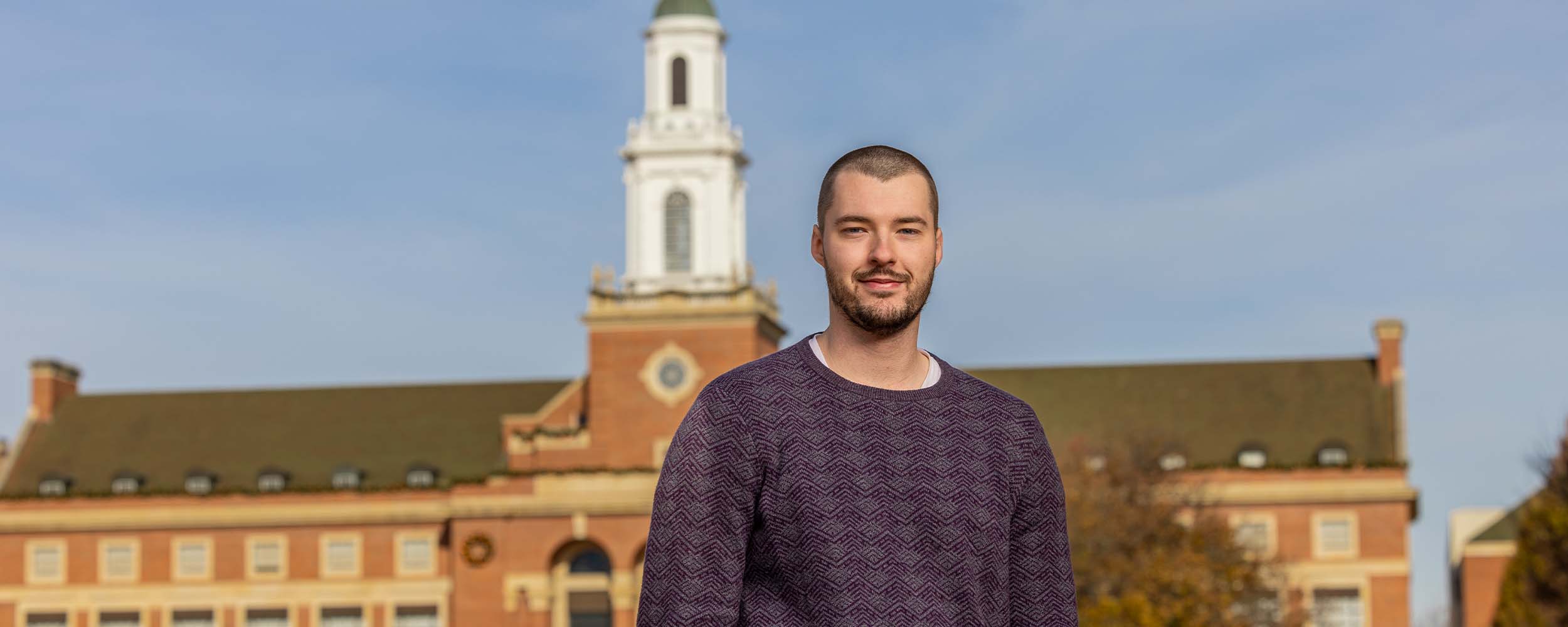
Bennett Upton, a recent Oklahoma State University graduate from Frisco, Texas, has been named a finalist for the illustrious Gates Cambridge Scholars Program.
OSU sat down with the biochemistry and molecular biology alumnus to learn more about how he continues to dream as big as the sky, his finalist designation, his future academic plans and why he chose to pursue his undergraduate degree at OSU.
Question: When did you know that biochemistry and molecular biology were areas you wanted to study?
Bennett Upton: That's a good question. I think in middle school, I knew I wanted to go into hard science. I remember I was really interested in biology. After that, I took a health class, which I thought was interesting. Then in high school, I took AP biology, and I got exposed to molecular biology information, and I latched on to it. Now that I'm here at OSU, I'm doing that degree program, and I've been able to narrow it to virology, the study of viruses — that's what I'm really interested in.
Q: Why was OSU the place to pursue your undergraduate degree?
BU: The ability to do undergraduate research was a big reason why I chose to come to OSU. I really like the hands-on activity of research. I can sit and learn all I need to, which is fun, but being able to actually get in a lab and pipette and develop protocols — it's like baking, but it's a lot more fun. It’s a very structured process — you add this much of this reagent, and you do this, and you put it in this machine — something about it is very, very fun.
I also like the independence of doing research. I think as I've learned more and more about the way that I learn, it's very independent-driven. I do very well in my classes, but it's nice to kind of go at my own pace and learn things when I want to.
Q: Now that you’ve finished your undergraduate degree, what’s next for your academic journey?
BU: I’ve been accepted into a Ph.D. program in the Department of Pathology at the University of Cambridge. I got accepted into Dr. Colin Crump's lab, which is looking at the herpes simplex virus (HSV), and particularly what proteins are involved in reactivation of HSV in the neuron. HSV is a lifelong infection. It gets integrated into your neurons during its latency, and there's a lot of interesting research to show that different stressor factors or environmental stimuli can cause the reactivation of this virus, and then you can infect it through other people. Those mechanisms aren't really that well known — so that's what I'm going to be doing my thesis on.
Q: What does it mean to you to be named a finalist for the Gates Cambridge Scholars Program?
BU: I feel very happy about it. I'm a little nervous, of course, but it’s a huge honor. Just being nominated for an interview is an honor. I called my mom and said, “Oh my gosh. I just got an interview.” Also, the support I’ve had from everyone has been amazing — helping with travel, accommodations and really the entire process.